
Two Biz Besties on AI, Custom Bots, and What Nobody Tells You About Building in Public
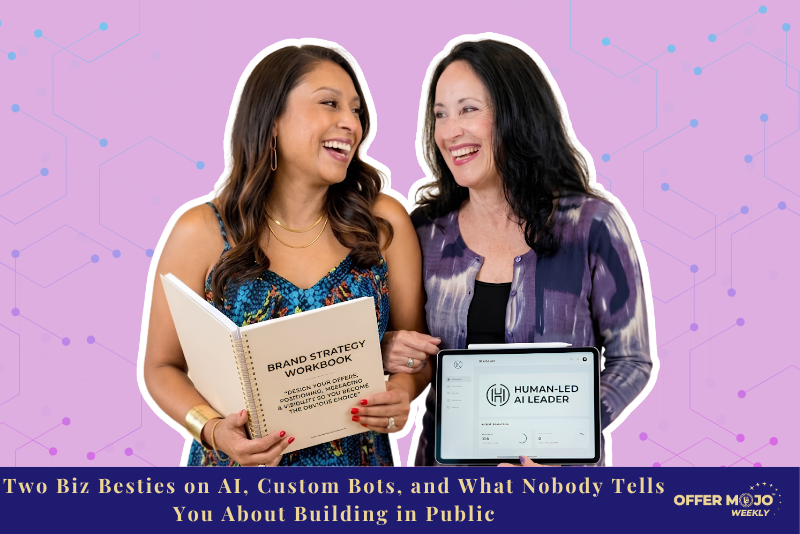
I want to tell you something I don't think gets said enough in conversations about AI and online business.
Building something genuinely new is scary. Not in a dramatic, cinematic way. In a quiet, middle-of-the-night, did-I-just-waste-three-months kind of way.
I spent the better part of fall 2024 building the OfferMojo Squad, a suite of six AI-powered offer assistants, each one trained on the frameworks I use with my one-on-one clients. Every assistant has a specific job: Grace handles strategy and positioning, Kate handles offer structure, Elliot maps the ecosystem, Theo refines messaging, Avery covers visibility and launch, and Kai closes the sales page. Together, they walk someone through the full lifecycle of building an aligned, sellable offer.
It took me three months to build and test. Three months of late nights, instruction documents, knowledge files, version after version of prompts that didn't quite work the way I needed them to. And the whole time, I kept thinking: who does this? I'm a strategist, not a developer.
But I had a collaborator in all of it. Mallika Malhotra, brand strategist and founder of The Brand CEO, was building her own suite at the same time. The Brand Force five AI brand assistants trained on her proven frameworks for niche clarity, messaging, and brand positioning. We were both knee-deep in something we'd never done before, texting each other through the hard parts, celebrating the small wins, and being completely honest about the moments we wanted to walk away from the whole thing.
We launched within weeks of each other in fall 2025. And then something happened that neither of us talks about nearly enough.
TL;DR
Building AI-powered tools on your expert frameworks can transform how you deliver offers and serve clients but the launch reality is more complex than the highlight reel suggests. This post covers the honest story behind two strategists who built custom AI suites simultaneously, what they learned about why coaches hesitate to invest in expert-built AI, why generic prompting falls flat compared to framework-trained tools, and how to start integrating AI into your business without losing the human element that makes your work irreplaceable.
What actually happens when you launch something new into a market that isn't ready for it yet?
The honest answer is: you learn a lot, you make back some of your investment, and you do some real recalibrating.
My waitlist launch for the OfferMojo Squad went reasonably well. I made back my profit, which for a brand-new offer felt like a green light. Then I launched to my full email list. And I got zero sales.
Mallika's experience with the Brand Force was similar. Her single AI tool, Lumi, had launched well a few months earlier. The full suite? The market wasn't quite ready to receive it the way she'd hoped.
We've both been transparent about this in our own communities, and I want to be transparent here too, because I think the polished version of "I built a thing and it took off" does a real disservice to everyone who's building something right now and wondering why the traction isn't matching the effort.
The harder question is: why does this happen, even when the tool is genuinely good?
The AI hesitation is real, and it's not irrational. When someone considers investing in an AI-powered tool even from a strategist they trust, even at a fraction of the cost of one-on-one work they're carrying a set of legitimate fears. Will I actually use this? Will I know what to do with it? What if the technology changes and it becomes obsolete? What if I pay for it and it just gives me the same generic output I could get from ChatGPT for free?
That last one is the one I want to sit with for a minute, because I think it's at the center of why expert-built AI tools are so hard to sell right now, even as they're more valuable than ever.
What actually happens when you launch something new into a market that isn't ready for it yet?
The honest answer is: you learn a lot, you make back some of your investment, and you do some real recalibrating.
My waitlist launch for the OfferMojo Squad went reasonably well. I made back my profit, which for a brand-new offer felt like a green light. Then I launched to my full email list. And I got zero sales.
Mallika's experience with the Brand Force was similar. Her single AI tool, Lumi, had launched well a few months earlier. The full suite? The market wasn't quite ready to receive it the way she'd hoped.
We've both been transparent about this in our own communities, and I want to be transparent here too, because I think the polished version of "I built a thing and it took off" does a real disservice to everyone who's building something right now and wondering why the traction isn't matching the effort.
The harder question is: why does this happen, even when the tool is genuinely good?
The AI hesitation is real, and it's not irrational. When someone considers investing in an AI-powered tool even from a strategist they trust, even at a fraction of the cost of one-on-one work they're carrying a set of legitimate fears. Will I actually use this? Will I know what to do with it? What if the technology changes and it becomes obsolete? What if I pay for it and it just gives me the same generic output I could get from ChatGPT for free?
That last one is the one I want to sit with for a minute, because I think it's at the center of why expert-built AI tools are so hard to sell right now, even as they're more valuable than ever.
| Question | Y | N |
|---|---|---|
| Do you have a documented framework or process you use with clients? | ||
| Could you write down the questions you always ask at intake? | ||
| Do you know which parts of your delivery feel repetitive or time-consuming? | ||
| Have you ever typed a client request into generic AI and felt underwhelmed by what came back? | ||
| Do you have a clear sense of what only you can do — the human judgment part of your work? |
If you answered yes to most of these, you have more than enough to start building internal AI processes. Your framework is the foundation. Everything else is just learning the tools.
What it costs to stay on the sidelines of AI entirely
I want to be careful here, because I'm not interested in manufacturing urgency or telling you that if you don't act now you'll be left behind. That's not how I think about business strategy and it's not what I've seen in the data.
But I do think there's a real cost to staying in observation mode indefinitely.
The coaches and experts who are building now building internal processes, building lead magnets, building client delivery systems powered by their own frameworks are creating something that compounds. Every hour they're not spending on repetitive output is an hour they're spending on the work only they can do. Every client who goes through a well-built AI intake process gets a better first experience. Every offer that's been structured with a framework-trained tool is more likely to be clear, differentiated, and positioned to sell.
The gap between "using AI occasionally when I remember" and "building AI into the foundation of how I work" is real. And it grows over time.
That doesn't mean you need to do everything at once. It means the conversation you keep putting off the one where you sit down and ask yourself what your methodology actually is and how you could encode it is worth starting today.
Frequently Asked Questions About Building AI into Your Expert Business
What's the difference between using ChatGPT and using an expert-built AI tool?
Generic AI gives you answers based on everything it's been trained on across the internet. Expert-built AI tools are trained on a specific practitioner's framework, methodology, and way of working with clients. The questions are different, the parameters are different, and the output reflects real strategic depth rather than general-purpose advice. The difference in quality is significant and most people who've used both notice it immediately.
Do I need to be tech-savvy to build an AI tool based on my framework?
No. Mallika and I are both strategists, not developers. Building custom AI tools requires learning, patience, and a lot of testing but not programming skills. The hardest part is usually documenting your framework clearly enough to train the tool on it. If you can explain your process to a new team member, you can train an AI tool on it.
How long does it take to build a custom AI suite like the OfferMojo Squad or Brand Force?
For me, it took about three months from initial concept to tested, ready-to-launch product. That included building the knowledge documents, writing the instruction sets, testing with real scenarios, refining based on what wasn't working, and doing it all over again. It's not a weekend project but the investment pays off in delivery speed and consistency.
Should I build my AI tool on ChatGPT or Claude?
It depends on where your audience is and what output quality you need for your specific use case. ChatGPT has broader adoption right now more of your clients are likely already using it. Claude is producing meaningfully stronger output for certain types of strategic work. The most important thing is to not get so attached to one platform that you can't move when the landscape shifts. Keep your knowledge documents and instruction files in a format you can transfer.
Will AI tools replace the need for one-on-one coaching or strategy work?
No at least not for the kind of deep, relational, judgment-intensive work that good strategists and coaches do. AI tools can handle the repeatable, process-driven parts of delivery. What they can't do is hold space for someone who's in the messy middle of building something, push back when a client is thinking too small, or connect the dots in a way that requires the lived experience of having done the work yourself. The human element is not a soft extra. It's the thing that makes the whole thing work.
How do I know if my framework is strong enough to build an AI tool on?
If you have a repeatable process you use with clients even an informal one you have the raw material. The question is whether you can articulate it clearly enough to train a tool on it. Start by writing out the questions you always ask, the steps you always take, and the common mistakes or traps you always watch for. If that document makes sense to someone who's never worked with you, you're further along than you think.
What's the best first step if I want to integrate AI into my business?
Start internally, not publicly. Take one part of your delivery that feels repetitive an intake process, a report format, a feedback template and train an AI tool to help you handle it. Get comfortable with what works and what doesn't before you build anything client-facing. The experience you gain internally will make everything you build later significantly better.
Is it worth investing in an expert-built AI tool if I'm already using generic AI?
If you're already using AI and feeling like the output is fine but not quite right, yes. The difference between generic prompting and a tool built on a specific expert's methodology is the difference between a generic internet search and a consultation with someone who has spent years thinking about your exact problem. If the framework behind the tool is solid and proven, the output will reflect that.
What's Next?
If this conversation is making you think about your own offer whether it's clear enough, differentiated enough, structured to actually sell the OfferMojo 6-Pillar Offer Audit is the place to start. It's a focused 60-minute diagnostic where we look at your offer across six pillars: strategy, structure, messaging, ecosystem, visibility, and sales. You walk away with a clear picture of where the gaps are and a prioritized action plan for what to fix first.
It's not a pitch session. It's an honest look at what's working and what isn't, from someone who has spent years building offers that are both aligned and profitable.
Book your offer audit here: https://www.onamissionbrands.com/offermojo-audit
About Lori Young
Lori Young is the creator of the OfferMojo framework and the founder of On a Mission Brands. She is an offer strategist, messaging, and business positioning expert who helps transformation-focused coaches, consultants, and subject matter experts design offer ecosystems that elevate their authority and reflect the true depth of their expertise.
About Mallika Malhotra
Mallika Malhotra is an award-winning brand strategist, mentor, and speaker who helps women entrepreneurs discover their power niche, develop their signature framework, and amplify their authority online. With a background in corporate advertising and years spent helping visionaries clarify their message, Mallika specializes in turning personal brands into category leaders. She is the creator of the Brand Authority Accelerator and a passionate advocate for showing up boldly and consistently, without losing your soul in the process.
Website: https://www.thebrandceo.com
Instagram: https://www.instagram.com/thebrandceo
LinkedIn: https://www.linkedin.com/in/thebrandceo
Get your free brand audit with Snap: www.thebrandceo.com/snap
Explore the Brand Force AI Suite: https://thebrandceo.com/brand-force
