
Ditch the PDF: How Interactive Lead Magnets Grow Your Email List Faster
TL;DR
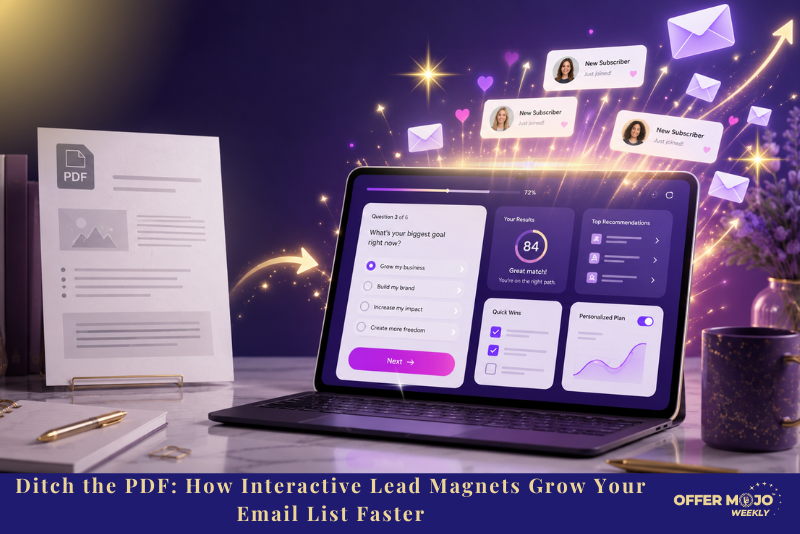
Static PDF lead magnets have been losing their effectiveness for years, and AI has accelerated that shift dramatically. This post covers what makes an interactive lead magnet actually work, the difference between a quiz and an AI-powered tool, Kylie Kelly's V2 Framework for growing your email list without social media, how to protect your IP when you go public, and exactly where to start if you've never built one before.
About a year ago, a friend in the business world told me I needed to turn my expertise into AI tools. Public-facing ones. And I panicked a little.
My back-end AI tools were one thing. I'd been using them in my own work for a while. But putting them out into the world, where anyone could interact with them, judge them, find the gaps, that felt different. I thought: if it's public, it has to be really good.
So I took a breath and built it anyway. My first interactive lead magnet was the AI-Powered Offer Confidence Toolkit. I gave people the option of a PDF checklist too, just in case they weren't ready to interact with an AI tool. But the main experience was the tool itself. And that lead magnet has become the most popular thing I've ever offered in ten years of business. Not a paid program. Not a launch. A free interactive tool.
That result made me pay attention in a different way.
When I connected with Kylie Kelly, email strategist and founder of Email Marketing School, I wanted to understand what she was seeing from her side of this. She has been teaching list growth and email strategy for years and made the call to walk away from social media entirely back in 2022. She has over 7,000 email subscribers, a Skool community of 1,100 members, and has been featured in Forbes, Business Insider, and Business Mondays. And she did all of it without posting on Instagram.
This conversation is about what's actually working right now for coaches, consultants, and experts who want to grow an audience they own.
Why Are PDF Lead Magnets Stopping Working?
PDF lead magnets are losing effectiveness because your audience can now get the same information in thirty seconds from an AI tool, without giving you their email address.
Kylie has been watching this shift longer than most people have admitted it was happening. She told me she'd already started coaching her clients not to obsess over making their PDF that great. Just focus on the opt-in page and the subject line, get people on the list, and build trust from there. Because half the people, as she said plainly, won't even open the PDF.
That was before AI made the problem worse. Now, the gap between a static document and a quick AI search has never been narrower. If your lead magnet delivers information someone can get faster and more specifically from ChatGPT or Claude, it's not a lead magnet anymore. It's a download that sits in a folder and collects digital dust.
What's replacing it isn't more content. It's experience: something personal, immediate, and specific to the person asking.
What Makes an Interactive Lead Magnet Actually Work?
An interactive lead magnet works when it gives the user a personal, specific outcome based on their own inputs, not a generic result that applies to everyone.
Kylie's definition cuts through the noise. Forget about the format for a second. The question is: does the person who uses this tool walk away with something that feels like it was made for their situation? If yes, it's working. If they're getting the same output as the person who used it before them, it's not.
She traced the lineage of interactive lead magnets back to the old-school quiz. Quizzes were always interactive in spirit. They were always trying to give people a personalized result, to sort them into categories, to make them feel seen. What AI has changed is the precision and the speed.
Quizzes vs. AI-powered tools.
A quiz gives you four to six possible outcomes based on a handful of questions. The branching logic is set in advance. If you want to add more nuance, you need more expensive software and more complicated builds. An AI-powered tool, on the other hand, takes someone's specific input and gives them something that actually responds to their particular situation. It's more granular, more conversational, and with the right prompting, more branded, without the cost or the complexity of traditional quiz software.
Kylie's custom GPT, Subject Line Sally, is a perfect example. She built it for her membership of about 250 people so they could access her email strategy advice while she was asleep. She's in Australia. Her audience is mostly in the US. It made sense to give people a tool they could use at 2am their time when she wasn't available. Then she made it public. Subject Line Sally got over a thousand organic downloads without any paid promotion. And what surprised Kylie most was this: people reached out to hire her directly off the back of a free tool. That had never happened with a static lead magnet. A freebie had always been a long-game trust builder. Subject Line Sally compressed that timeline dramatically.
Quick Diagnostic: Is Your Current Lead Magnet Still Working?
If you're not sure whether your lead magnet is pulling its weight, use this to check.
| Question | Yes | No |
|---|---|---|
| Do most people who download it actually open or use it? | ||
| Does it give a personalized result based on the user's specific input? | ||
| Does it lead naturally into a conversation about your paid work? | ||
| Have you had anyone reach out to work with you directly because of it? | ||
| Does it feel like a genuine sample of your expertise, not just information? | ||
| Has it brought in new subscribers in the last 90 days without active promotion? |
More no answers than yes is a useful signal. It doesn't mean the topic was wrong. It usually means the format is the problem.
How Do You Grow Your Email List Without Social Media?
You grow your email list without social media by investing in two lanes simultaneously: relationship-based strategies that give you faster results, and search and SEO strategies that compound over time.
Kylie calls this her V2 Framework. Picture a capital V. One side is relationship-based. The other is search and SEO.
The relationship side includes summits, bundles, podcast guesting, freebie swaps, and traditional networking. Anywhere you're showing up in someone else's audience in a way that creates a mutual win. These strategies tend to pay off faster. You see new subscribers more quickly, which gives you the energy and momentum to keep going while the slower lane builds.
The search and SEO side is your long-form content: podcasting, blogging, YouTube, Pinterest, traditional PR. This side takes longer to gain traction, but it compounds. Kylie's podcast, the Email Growth Show, is her SEO strategy. It goes on her website with optimized show notes, which means it keeps working after it publishes. Then she gets to play on the relationship side, doing bundle collaborations, hosting summits, swapping freebies when her schedule allows.
The practice is simple: pick one strategy from each side, give it 90 days, look at the results, and check how it feels. Then decide whether to continue or try something else. You don't have to do all of it. You just have to choose and commit long enough to see real data.
For me, bundles have been the most effective way to promote my interactive lead magnets specifically. Last year I contributed GPTs from the OfferMojo Squad to several bundle collaborations, and the results were meaningfully better than mentioning the tools in a podcast or a social post. Kylie's word of caution here is worth repeating: be specific. A broad bundle topic attracts a broad audience. If you're contributing a highly specific offer, you'll attract the people who actually need what you do. That's the only kind of list growth that leads anywhere useful.
How Do You Choose What Interactive Lead Magnet to Build?
Start by reverse engineering from your signature offer, then let your audience's most pressing problem right now shape the format.
Kylie's rule is non-negotiable for her: she always starts with where she wants to lead people. The lead magnet is the on-ramp. If you build the on-ramp without knowing where it leads, you end up with a list of subscribers who never convert. There's nowhere natural for them to go.
She was honest about the fact that this is harder to follow when you love building things. She has a genuine creative appetite for making tools. So she created a treasure chest inside her Skool community, a place for all the tools she wants to build that don't necessarily fit into her main offer ecosystem. Her community members get the value. Her public-facing lead magnets stay strategically focused.
I relate to this completely. If you listen to me talk about offers for any length of time, you know I think the same way about offer ecosystems. Every offer has a job. A lead magnet's job is to bring in the right person and demonstrate enough of your expertise that they want to take the next step. If it's doing that job, it belongs. If it's pulling in random subscribers with no connection to your paid work, it's costing you more than it's giving you.
What Is the Real Cost of Keeping a Static Lead Magnet That Isn't Working?
Keeping a lead magnet that isn't working costs you trust, conversion, and the compounding value of a list that actually knows what you do.
Here's what actually happens when your lead magnet isn't landing. People opt in and never open it. Your open rates look fine because they're already subscribed, but engagement on follow-up emails drops off because the relationship started with a thud. They don't feel like they got something real from you. They feel like they traded their email address for a PDF that didn't deliver on what the opt-in page promised.
Over time, that erodes the quality of your list. Not just the numbers, but the actual quality of the people on it. A list full of people who aren't experiencing your expertise, who never got that first taste of what it's like to work with you, is much harder to sell to than a list built around a tool that actually showed them something.
And there's a subtler cost too. When you're promoting a lead magnet you don't believe in, it shows. Your copy is less enthusiastic. Your follow-up sequence feels like an obligation. Your sales calls start with people who barely remember what they signed up for. The whole thing becomes friction.
The good news is that fixing this doesn't require scrapping everything. It usually means changing the format, not the topic. The thing you know, the framework, the diagnostic, the process, is often still the right subject matter. What needs to change is how someone gets to experience it.
Frequently Asked Questions About Interactive Lead Magnets
What is an interactive lead magnet and how is it different from a PDF?
An interactive lead magnet is any tool that gives the user a personalized, specific outcome based on their own inputs. A PDF delivers the same information to every person who downloads it. An interactive tool (whether it's a quiz, a calculator, an AI-powered assistant, or a custom GPT) responds to what the specific user tells it. That personalization is what makes the experience feel valuable rather than generic.
Do I need to know how to code to build an AI-powered lead magnet?
No. Kylie Kelly built her first custom GPT with no coding knowledge at all. The most accessible starting point is a custom GPT in ChatGPT or a Claude artifact, both of which can be built through a conversational prompting process. Brain dump what you know into a Loom recording, pull the transcript, take it into your AI tool of choice, and ask it to help you build something useful from your expertise. The technical barrier is lower than most people think.
How do I protect my IP when I share an AI tool publicly?
This is critical: do not share your AI tool as a public Claude artifact. Anyone who accesses a public Claude artifact can click a customize button and download the entire back end of your tool, including your methodology, your frameworks, and your prompts. Host your tool externally instead. Kylie uses GitHub. I had a developer build and host the Offer X-Ray in a completely protected environment. If you're building something that contains your real intellectual property, it needs to live somewhere secure.
How do interactive lead magnets compare to quizzes in terms of conversion?
Both outperform static PDFs significantly. Industry benchmarks put quiz and assessment lead magnets at 30-50% conversion, compared to 3-10% for static PDFs. AI-powered tools can match or exceed that range because the output is more granular and the experience feels more personal. The bigger distinction between a quiz and an AI tool is depth: quizzes offer four to six possible outcomes; AI tools can respond to the specific nuance of what someone shares.
What should my interactive lead magnet lead people toward?
It should lead directly toward your signature offer or the next logical step in your client journey. Kylie's rule is to always reverse engineer from the paid offer you most want people to move toward. The lead magnet's job is to give people a taste of your expertise and a reason to want more. If there's no clear path from the free tool to the paid offer, the lead magnet builds goodwill without building business.
How do I promote an interactive lead magnet once it's built?
Start with four placements on your homepage, your email signature, and wherever your social links live. Then go to your existing network: past clients, collaborators, podcast guests, community members. Give them early access and ask for honest feedback and testimonials. That social proof does more for early traction than any organic content mention. From there, bundles and collaborations are where most coaches see real list growth. Be specific about what you contribute so you attract the right people, not just volume.
Is it worth building an interactive lead magnet if I already have a small list?
Yes, and arguably it matters more when your list is small. Every subscriber on a small list carries more weight. If your current lead magnet is bringing in people who don't connect with your work, you're building a list that's hard to sell to from the start. An interactive tool that gives people a real experience of your expertise builds a smaller but much more engaged list. And engagement is what converts.
How do I know if my interactive lead magnet is actually working?
Look at three things: opt-in rate, usage rate, and downstream behavior. A good opt-in rate suggests the hook and the promise are landing. Usage rate (whether people actually interact with the tool, not just click the link) tells you whether the experience is delivering. And downstream behavior is the real signal: are people from this lead magnet opening your emails, responding to them, and eventually buying? If all three are moving in the right direction, the tool is doing its job.
What's Next?
If this conversation has you looking at your lead magnet differently, or thinking about what you'd actually build if you were starting fresh, the right first step might be getting clear on the offer ecosystem your lead magnet is supposed to feed.
The Offer X-Ray is an AI-powered diagnostic that audits your offer across six pillars: strategy, structure, messaging, ecosystem, visibility, and sales. It tells you exactly where the gaps are so you know what to focus on, what to fix, and what to stop doing. If your lead magnet isn't converting the way you want it to, there's often something upstream in your offer that needs attention first.
Founding member rate is $47 until July 31, 2026.
About Lori Young
Lori Young is the creator of the OfferMojo framework and the founder of On a Mission Brands. She is an offer strategist, messaging, and business positioning expert who helps transformation-focused coaches, consultants, and subject matter experts design offer ecosystems that elevate their authority and reflect the true depth of their expertise.
About Kylie Kelly
Kylie Kelly is an email strategist and founder of Email Marketing School who helps online business owners grow their email list and make sales without relying on social media. She built her audience from scratch using simple, relationship-first strategies that feel good, work fast, and create trust that converts. She has over 7,000 email subscribers and a community of 1,100 members, and has been featured in Forbes, Business Insider, and Business Mondays.
Website: https://kyliekelly.com/
