
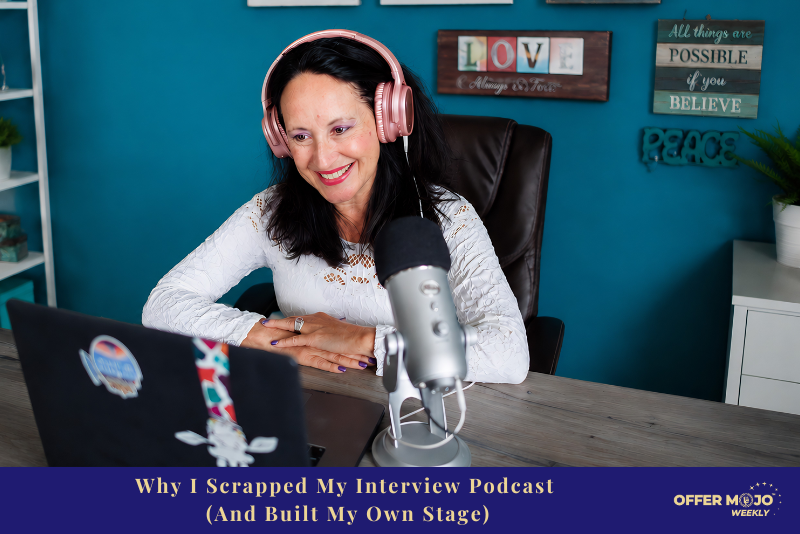
Why I Scrapped My Interview Podcast (And Built My Own Stage)
TL;DR
Switching from a guest-heavy interview podcast to a solo-led, niche show was the single biggest visibility decision I've made in my business. This post covers what I learned about the authority gap, anchor content, and why a visibility strategy only works when it's built around you, including a self-assessment to help you evaluate your own.
For an entire year, I showed up every single week and built a beautiful stage. I just wasn't standing on it.
I launched my first podcast in 2024. It was called On a Mission Mojo, and the idea was simple and honestly really beautiful: give mission-driven entrepreneurs a platform to share their expertise and their work with the world. I interviewed 52 guests that year. I loved it. I turned out to be a natural host, which genuinely surprised me. There's something about sitting across from someone, drawing out their story, making them feel heard in a conversation. That felt like home.
But somewhere around month nine or ten, I started noticing something I didn't want to look at. Ninety percent of my guests never shared their episode. And what that meant in practice was that I was creating content week after week that wasn't growing my audience, wasn't building my community, and wasn't generating leads. The harder thing to sit with: nobody was learning what I actually did. They were hearing great conversations. But me? I was the host. I was in the background. I was invisible.
And the podcast was only one piece of a much bigger thing that was falling apart.
My business wasn't working. I was being too general in my positioning, burnt out, over-giving to everyone around me, and getting further from where I wanted to be. And then I hit a wall. It kind of was a dramatic breakdown. I literally burst into tears. Something in me just said: I'm done. This is not working. I cannot keep doing this.
So I changed everything, kind of all at once. I narrowed my expertise, committed fully to offer strategy and positioning as my lane, and decided the podcast was changing too. Because if I was finally going to get serious about my own visibility and my own authority, I had to stop building stages for everyone else and start building one for myself.
This post is the behind-the-scenes on that decision: what I learned, what shifted, and what it means for how you think about your own visibility strategy.
What is the authority gap in podcasting, and why does it matter for coaches?
The authority gap is the distance between being a skilled, generous podcast host and being seen as a credible expert in your field. You can be excellent at one and completely invisible at the other.
A guest-heavy podcast builds your reputation as a connector, a community builder, a generous human. And that's amazing. But it doesn't automatically build you as the authority. That only happens when people consistently hear you think, teach, and lead. When I was hosting On a Mission Mojo, I was great at drawing out other people's brilliance. The problem was that nobody was seeing mine.
The authority gap closes when you become the consistent voice on your own platform. Not the facilitator of other voices, but the voice itself. For me, that meant making the pivot to a solo-led show where 75% of the content was just me. My frameworks, my stories, my way of thinking about offers. The other 25% were guests who added depth to the conversation I was already leading, not guests who replaced it.
About six months into The OfferMojo Show, I got a message I still think about. Someone had listened to one of my episodes, gone directly to my website, and booked and paid for an Offer Power Plan without ever meeting me. When we connected for her session, I found out she had the exact same birthday as me. Which honestly felt like the universe sending me a message, which I am totally here for. She told me she had totally resonated with my podcast episode. That's the authority gap closing in real time.
Why does a guest-heavy podcast struggle to grow your audience?
When 90% of your podcast guests don't share their episode, your platform growth depends almost entirely on your own promotional efforts. The model that promises cross-pollination of audiences rarely delivers it consistently.
This isn't a criticism of guests. They're busy. Their audience is different from yours. Life happens. But the structural reality is this: a show built primarily around other people's content puts your growth in other people's hands. And when you're trying to build visibility for your own offers and expertise, that's a shaky foundation.
What actually builds your audience is showing up as yourself, consistently, on your own platform. The listeners who found The OfferMojo Show found it because of me. My voice, my topics, my specific way of talking about offers. They weren't cross-referred. They came looking for what I specifically do. That's a fundamentally different kind of growth.
The 10x podcast growth I saw in the first year of The OfferMojo Show wasn't because I had better guests or a bigger promotional budget. It was because the show finally had a clear identity. It was mine.
What is anchor content and how does it make a visibility strategy more sustainable?
Anchor content is the single piece of content that everything else flows from. It's the hub. When you have one, your entire content process gets simpler, your messaging gets more consistent, and your visibility compounds over time instead of scattering.
Before I made the podcast my anchor, I was creating content in all directions. A blog here, a newsletter there, a social post here, a podcast episode there. None of it connected. None of it was building toward anything. The moment I decided the podcast was the hub and everything else flowed from it, something clicked. The newsletter became easier. The blog became easier. The social content had a direction.
The podcast and my blog are now my biggest lead generators. Not Instagram. Not LinkedIn. Every time I ask a new inquiry how they found me, the answer is always the podcast or AI search. Never social media. I want you to really hear that, because a lot of us have been told social media is the thing. For some people it genuinely is. But for me, and for a lot of the coaches I work with, it's not. The content I've put the most care and strategy into is the content that's actually working.
How do you build a visibility strategy that fits your personality and nervous system?
The visibility strategy that grows your business has to be built around you. Your personality, your strengths, your capacity, and what your nervous system can actually follow through on consistently.
When I'm building a visibility plan with a client, the first thing I look at is not platforms. It's them. Do they love being on camera or does it make them want to hide? Are they a writer or a talker? Do they have five hours a week for visibility or one? What can they actually sustain without burning out or dreading it?
The most perfectly designed visibility strategy does nothing if you can't follow through on it. And most of us are not great at predicting in advance what we'll actually do versus what sounds good in theory. I love podcasting. Genuinely love it. That's not a small thing. That's why it works. If I hated it, none of the strategy in the world would make it sustainable.
Two conversations happened right around the time I made my pivot that I think about often. The first was with a peer, another offer strategist, who told me: "If you're going to be an offer strategist, you need to be able to build your own offers." At first it stung. She didn't know my full background. But what started as a sting became fuel. She was right, not in the way she meant it maybe, but in the way I needed to hear it.
The second was with Drashti, my copywriter on my team. I asked her straight up: "What do you think I'm good at?" She said: "You are so good at seeing the genius in people and helping draw that out." And I sat there thinking, what does that have to do with offer strategy? Everything. It has to do with everything. Your genius, your brilliance, your specific way of seeing the world is the foundation of every great offer. Hearing that from someone who worked closely with me gave me permission to finally own it.
When I work with clients on visibility strategy, I always ask: what level of visibility are you going for? There are three levels I work with. Starter is manageable, sustainable, and gets you consistently visible without burning you out. Momentum is more volume, more reach, more consistent growth. Bold is all out, multiple channels, high visibility. There's no right answer. There's just your answer, the one that matches your capacity, your goals, and your actual energy.
Quick Diagnostic: Is Your Visibility Strategy Actually Working For You?
Run through these questions honestly. If you're checking "no" on more than two, your visibility strategy may need a rethink.
| Question | Yes | No |
|---|---|---|
| My primary visibility strategy puts my expertise in front of the right people | ||
| I look forward to showing up in my chosen visibility channels | ||
| My content has a clear hub that everything else flows from | ||
| I can sustain my current visibility strategy without burning out | ||
| People who find me understand what I do and who I help | ||
| My visibility strategy is built around my strengths, not someone else's playbook |
If you're mostly in the "no" column, that's not a failure. That's just useful information. It means your visibility strategy needs to be rebuilt around you.
What does it actually cost to run the wrong visibility strategy?
Running a visibility strategy that doesn't fit you costs more than time and energy. It costs clarity, confidence, and momentum.
When you're showing up everywhere you think you should be but none of it feels like you, your message fragments. Different platforms, different tones, different angles, none of it building toward a clear, recognizable identity. You work harder and stay more invisible, which is exhausting in a particular kind of way because you can't even point to what's wrong.
There's also the nervous system cost. Doing visibility work you dread or that drains you means you'll always be fighting yourself to stay consistent. And inconsistency is the thing that kills visibility strategies more than anything else. Not bad content. Not the wrong platform. Inconsistency.
The version of me that spent a year hosting a beautiful podcast for other people was not the version that built a business. I don't regret it. I learned that I love podcasting, that I'm good at it, and that the format fits my brain and my energy. But the version of me that finally claimed her own stage, made her expertise the thing, and built a content strategy that was actually mine? That's the version that started generating real leads, real clients, and real momentum.
You don't have to build anyone else's stage. You get to build your own.
Frequently Asked Questions About Podcast Strategy for Coaches
Should coaches have a podcast to build their authority?
Podcasting is one of the most effective authority-building strategies for coaches, but only when the show is built around your own expertise. A guest-heavy interview show builds you as a connector. A solo-led or hybrid show builds you as the expert. If your goal is to be seen as the go-to person in your niche, the format of your podcast matters as much as the fact that you have one.
Is it better to do solo podcast episodes or interview episodes as a coach?
Both formats have value, but solo episodes are more effective for building your personal authority. When listeners hear you teach, think through problems, and share your frameworks in your own voice, they build a relationship with you specifically. Interview episodes bring in new perspectives and can add depth to your topic. The most effective hybrid approach for coaches is roughly 75% solo and 25% guests who add to your core conversation, rather than the other way around.
How do you grow a podcast as a coach without relying on guests to share?
The most reliable podcast growth strategy for coaches is to build a show with a clear niche and consistent voice, then make it the anchor for all your other content. When your podcast drives your newsletter, your blog, and your social content, you create a compounding content ecosystem instead of relying on guest promotion to reach new people. SEO-optimized blog posts and strong show notes also help your episodes surface in AI search, which is increasingly where new listeners are finding shows.
How long does it take for a podcast to generate leads for a coaching business?
Most coaches see meaningful lead generation from a podcast around the six-month mark, assuming the show has a clear niche, consistent publishing schedule, and is promoted through other content channels. The leads that come from podcasting tend to be higher quality because the listener has spent significant time with you before reaching out. They arrive already trusting you, which shortens the sales conversation considerably.
What is anchor content and how does it help coaches stay consistent?
Anchor content is the single piece of content that everything else in your content strategy flows from. For many coaches, this is a podcast, a blog, or a YouTube channel. When you have one central piece of content per week that your newsletter, social posts, and other assets are all derived from, you dramatically reduce the cognitive load of content creation. Instead of inventing new angles every day, you're repurposing and amplifying one strong idea across multiple channels.
Why isn't my podcast growing even though I'm publishing consistently?
The most common reasons a podcast stalls despite consistent publishing are: the show lacks a clear niche or identity, the format isn't building the host's personal authority, the episodes aren't being promoted through other channels, and the show title and episode titles aren't optimized for search. Publishing consistently is necessary but not sufficient. The content itself needs a clear voice, a defined audience, and a distribution strategy beyond just uploading to a hosting platform.
How do coaches decide which visibility strategy is right for them?
The right visibility strategy for a coach is the one that matches their personality, capacity, and what their nervous system can sustain consistently. That means asking: Do I love being on camera or do I dread it? Am I a writer or a talker? How much time do I realistically have each week? What have I actually followed through on in the past, not what I intended to do? A visibility plan built around your honest answers to those questions will always outperform one built around what you think you should be doing.
Can a podcast replace social media as a visibility strategy for coaches?
For many coaches, yes. Podcast episodes and blog posts are long-form, searchable, and evergreen in a way that social media posts simply aren't. A well-produced podcast episode continues to surface in search months and years after it's published. Social media posts disappear in hours. If your goal is sustainable visibility that compounds over time rather than constant content creation for immediate reach, podcast plus blog is a more efficient strategy than social media alone for most coaches. That said, the best strategy is always the one you'll actually do consistently.
What's Next?
If this episode hit close to home, the next step is figuring out what your visibility strategy should actually look like. Not a borrowed playbook. Yours.
The Offer Visibility Sprint is a 90-minute intensive where we look at where you're currently showing up, where your authority is and isn't being built, and what a visibility plan designed around your specific personality, capacity, and offers actually looks like. You'll leave with a clear, actionable strategy you can start implementing right away.
Book your Offer Visibility Sprint here: https://www.onamissionbrands.com/offermojo-sprints
About Lori Young
Lori Young is the creator of the OfferMojo framework and the founder of On a Mission Brands. She is an offer strategist, messaging, and business positioning expert who helps transformation-focused coaches, consultants, and subject matter experts design offer ecosystems that elevate their authority and reflect the true depth of their expertise.
