
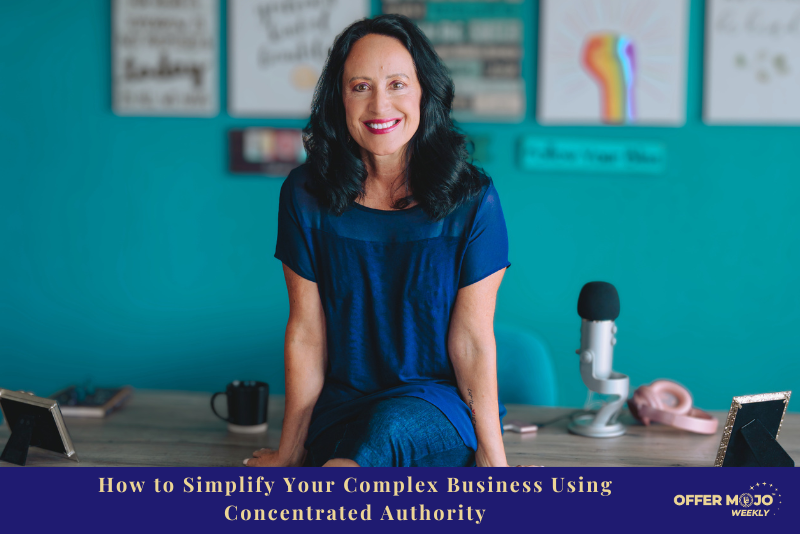
How to Simplify Your Complex Business Using Concentrated Authority
TL;DR
Simplifying your business isn't about randomly cutting things you're tired of. It's about rebuilding around your Concentrated Authority first, then your actual lifestyle, then your income goal, in that order. Business strategist Sonya Ramsey and I get into the real difference between offloading and simplifying, and why leading with one offer never means giving up the rest of what you're good at.
I have been quietly working on something for most of this year: getting my own business down to three, maybe four days a week. Not because less work sounds nice on its own, but because right now my business still asks for more of my time than it needs. The way I'm closing that gap, and the way Sonya Ramsey helps her clients do the same thing, is by simplifying in a specific order: positioning first, then your actual day to day, then your income goal, not the other way around.
That order is the whole conversation on this episode of the OfferMojo Show, part of our summer Refine and Recline series. My guest, Sonya Ramsey, spent years as an engineer and then in technical sales before she built her own coaching business in 2012. She got her start almost by accident, teaching guitar to musicians online, and now helps coaches, consultants, and experts find what she calls their Concentrated Authority: a message so specific and so clearly theirs that clients start finding them instead of the other way around.
Sonya hit her own wall at the end of 2025. Part owner in two different businesses, saying yes to nearly every custom project that landed in her inbox, she got to a point where her business felt like a second full-time job instead of something she'd built for herself. Her fix wasn't offloading a pile of tasks and hoping things got lighter. She rebuilt on purpose, starting with the parts of her business she genuinely wanted to keep.
That's the distinction this whole episode turns on, offloading versus simplifying, and it's a distinction I've been sitting with in my own business too. If you've ever wondered whether you have to blow up everything you've built to make it simpler, this conversation should change your answer.
What's the Real Difference Between Offloading and Simplifying Your Business?
Offloading means getting rid of things with no real direction behind it. Simplifying means being deliberate about which parts of your business stay, based on whether they fit the life you want to live.
Sonya put it plainly on the episode. Offloading still leaves you without a plan, you're just doing less of it. You can drop three services and still be running a business that keeps you up until two in the morning, because dropping tasks at random doesn't touch the actual structure underneath.
Simplifying looks different. It starts with a specific question: does this part of my business work, and do I love doing it? If something works and you love it, it stays. If it works but you hate it, that's where the real decision gets made, since plenty of profitable things are still worth walking away from. And if it doesn't work and you don't love it, there's no argument left for keeping it around.
This is the piece Sonya was honest about on the show. Once you've decided what stays, the fear doesn't disappear. You still wonder what you're giving up. But she watched the opposite happen in her own business. She hadn't worked harder to find new clients. People could just describe what she did in one sentence now, so they started sending her the right person without being asked.
What Is Concentrated Authority (And Why Isn't It Just a Niche)?
Concentrated Authority is Sonya's term for the specific combination of your experience, your client results, your training, and your personal history that makes your positioning yours and nobody else's. A niche tells someone who you serve. Concentrated Authority explains why it has to be you.
Sonya's frustration with the word "niche" is that it's too thin to do any real work. Saying "I'm a coach who helps women" or "I teach guitar" describes an audience, but it doesn't separate you from the hundred other people saying the exact same sentence. Concentrated Authority pulls from something deeper: the wins you've created for clients, the formal training behind what you do, and the specific personal path that got you here.
The market has gotten sharper about spotting the difference between the two, and that's not an accident. Buyers today have seen a wave of interchangeable messaging, especially now that AI makes generic copy easy to produce at scale. Sonya's read on it: the words sound the same, the promises sound the same, and buyers can spot that from a mile away in a way they couldn't back in 2012 when she started.
Getting Concentrated Authority right rarely happens on the first try. Sonya's advice is to bring in someone who isn't emotionally attached to your business to hear your positioning cold and tell you honestly whether it makes them lean in or whether it sounds like everyone else's. That's most of what a good coach is for in this part of the process.
What Order Should You Simplify In?
Sonya works through four steps in a specific sequence: get your positioning honest first, then take stock of what you like and hate doing, then design the day to day you want, then reverse engineer your income goal from all three.
Skipping straight to the income number is where most people go wrong, according to Sonya. You end up chasing a revenue target that has nothing to do with how you want to spend your time, which is exactly the trap she fell into before her own reset.
Step One: Get Honest About Your Positioning
This is the Concentrated Authority work above, done first because everything else gets built on top of it. Sonya's rule of thumb: if your message could belong to five other people in your industry, it isn't done yet.
Step Two: Run a Personal Heat Check
Before building anything else, Sonya asks her clients pointed questions. Do you want to be on camera, or does the idea drain you? Do you want to host a podcast, or would you rather stay behind the scenes? These aren't personality quiz questions. They determine what kind of business you can sustain.
Step Three: Design Your Day to Day
Sonya isn't talking about the four hour work week fantasy. She means deciding, honestly, what you want your working hours to contain: content creation, client calls, email writing, tech and systems work, and how many days you want off. This step comes before pricing, not after.
Step Four: Reverse Engineer Your Income Goal
Only once the first three are clear does Sonya work backward into a monetization path. There are multiple ways to hit any given number. A copywriting coach client of hers built his income almost entirely through storytelling emails, something Sonya is still learning to enjoy herself. The path has to match the person, not just the target.
Why Doesn't the Platform Everyone Else Swears By Always Fit Your Business?
The right platform depends on where your specific audience spends time looking for what you do, not on where you personally enjoy creating content or where a competitor happens to be getting traction.
Sonya's example from the episode was blunt. Musicians teaching guitar or piano online often pour their energy into Instagram and TikTok, because that's where they're comfortable, while treating YouTube like an afterthought. But the people searching for how to learn an instrument are on YouTube, not scrolling Instagram for entertainment. Google owns YouTube, and it's the second largest search engine after Google itself. Posting there doesn't require ten minute videos either. The same short form content works, it just needs to live in the place people are already looking.
I told Sonya about my own tug of war with this. I tried YouTube last year and found it felt like a grind, and I'm not even sure my audience is there, since I'm a strategist rather than a how-to teacher. What pulled me in was Substack, mostly because a mentor I respect kept talking about it. That's exactly the trap Sonya called out: chasing a platform because someone else is having success there, rather than because it's where your people are.
Quick Diagnostic: Is Your Business Simplified or Just Offloaded?
Run through these honestly. There's no scoring trick here, just a clearer picture of where you stand.
| Question | Yes | No |
|---|---|---|
| Could you describe what makes you different in one sentence, without listing your services? | ||
| Do you know exactly which of your current offers should get cut for good? | ||
| Does your calendar right now match the lifestyle you want? | ||
| Have you said yes to a project this year mainly because you didn't want to say no? | ||
| Are you posting on a platform because a peer swears by it, rather than because your audience is there? | ||
| Do you know how many days off a week you want? | ||
| If you dropped your least loved offer tomorrow, would your income structure survive it? | ||
| Have you asked someone outside your business to hear your positioning cold in the last year? |
More than three "no" answers usually means you're still offloading rather than simplifying. That's not a failure, it's just the next honest step.
What Does Staying Complex Cost You?
Staying complex costs more than your calendar. It costs the clarity your audience needs to refer you, the energy you have left for the work you love, and the confidence that comes from being known for one clear thing.
The most obvious cost of an overcomplicated business is time, but that's rarely the real damage. The deeper cost is what happens to your marketing when you're spread across everything at once. Sonya didn't dance around this: messaging that's watered down and full of buzzwords doesn't land with buyers anymore, and a business trying to be all things to all people usually produces exactly that kind of messaging, whether it means to or not.
There's a referral cost too, one that's easy to miss because it's invisible until you notice its absence. People refer clearly. If someone can't describe what you do in one sentence, they can't send you the right person, no matter how much they like you. Sonya watched this shift the moment she narrowed to one core offer.
And there's a slower cost that shows up in the body before it shows up on paper: the particular exhaustion of running a business that has become a job you didn't design. Sonya described it as feeling in over her head, like her business had quietly become a second full-time job rather than something she loved. A smaller, more honest structure resolves that kind of tired. More effort inside the same one never does.
Frequently Asked Questions About Simplifying Your Business
What does it mean to simplify a business instead of just cutting things?
Simplifying means deciding what stays based on whether it fits the life you want and whether it's working, not just removing things at random. Offloading tasks without a clear direction can leave you with fewer things to do and the exact same overwhelmed structure underneath. Real simplification starts with your positioning, moves through your lifestyle design, and only then touches your offers and your income plan.
What's the difference between a niche and Concentrated Authority?
A niche describes who you serve. Concentrated Authority explains why it has to be you specifically, pulling from your client results, your formal training, and your own personal history. Two people can have the identical niche and completely different Concentrated Authority, because the second one is built from experience that can't be copied.
How do I decide which of my offers to keep?
Ask two questions about each one: does it work, and do you love doing it. If both are true, keep it. If it works but you don't love it, that's the one worth seriously reconsidering, since plenty of profitable things aren't worth the toll they take. If it doesn't work and you don't love it, there's no case left for keeping it.
Is it possible to have a lifestyle business and still make good money?
Yes, but it takes a foundation first, not a shortcut. Sonya was clear that this isn't something that happens just by wanting fewer hours. The people who've built a genuine lifestyle business usually spent real time establishing a core offer and audience before they could pull back their schedule without losing income.
Will I lose clients if I stop offering everything I'm good at?
Not in the way most people fear. Leading with one core offer doesn't mean your other skills disappear. They show up later, once trust is already built. Sonya described this as something that happens on its own: clients start asking for additional help themselves, once they've already experienced your expertise on the thing you led with.
Where should I be posting content?
Wherever your specific audience already goes looking for what you do, not wherever you personally enjoy creating or wherever a competitor is currently getting traction. Sonya's example was musicians who default to Instagram and TikTok when their actual audience is searching on YouTube. The right platform question is always about the audience's habits, not your comfort or someone else's results.
How long does it take to simplify a complex business?
Longer than most people want to hear, and it varies based on how tangled the business is to begin with. Sonya's own reset took shape over about six months and she still describes it as new. The timeline depends less on effort and more on how honest you're willing to be about what to cut and what to keep.
What's the first thing to fix when a business feels too complicated?
Start with positioning, not your offers or your schedule. If your message could belong to five other people in your industry, everything you build on top of it will keep feeling complicated no matter how much you simplify around it. Get that specific first, then the lifestyle and income decisions get much easier to make.
What's Next?
If any part of this has you looking at your own offer and wondering whether it's built on solid ground, that's exactly what the Offer Pulse Check was made for.
The Offer Pulse Check is my free diagnostic that looks at the foundation underneath what you sell and scores it against five vital signs, starting with whether you're passionate about it. No pitch, no pressure, just a clear read on where your offer stands right now.
Take the Offer Pulse Check here.
About Lori Young
Lori Young is the creator of the OfferMojo framework and the founder of On a Mission Brands. She is an offer strategist, messaging, and business positioning expert who helps transformation-focused coaches, consultants, and subject matter experts design offer ecosystems that elevate their authority and reflect the true depth of their expertise.
About Sonya Ramsey
Sonya Ramsey is a business strategist who helps coaches, consultants, and online educators simplify a scattered set of offers into one clear, sellable core offer. She spent years in corporate, first as an engineer and later in technical sales, before building her own coaching business in 2012. She found early traction teaching musicians online, plays gospel guitar herself, and keeps eight guitars in her home studio. [FLAG: her location wasn't stated on the recording]
Website: https://sonyaramsey.com
Free Simplification Audit: https://sonyaramsey.com/simplify
