
She Shut Down Her Online Presence Before She Ever Called Me
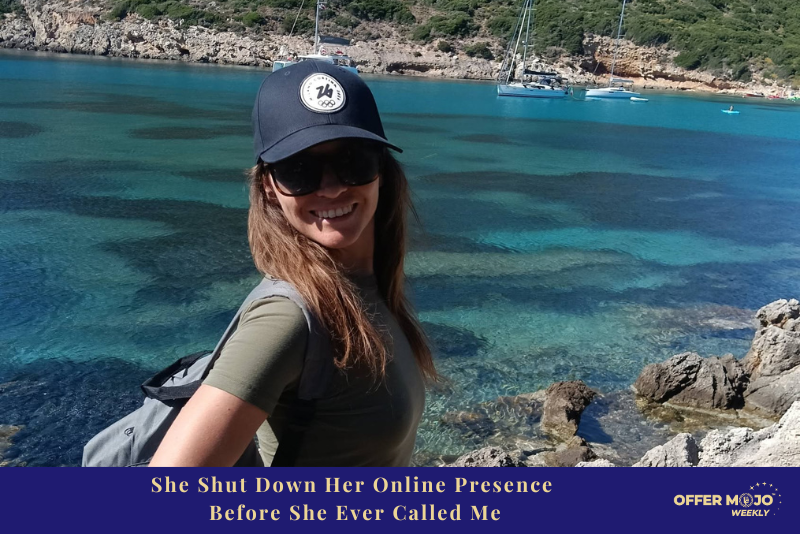
Client: Sabrina Colnago, Holistic Marketing Strategist
Offer Used: OfferMojo™ Studio
Industry: Marketing strategy for therapists and wellness professionals
Built: The W.H.O.L.E. Marketing Architecture Method
By the time Sabrina Colnago booked a call with me, there was almost nothing left of her business online.
Her website was down. Her Instagram account was closed. Her Facebook page had been abandoned.
Anyone who went looking for her online would have found very little.
But Sabrina hadn't shut down her business.
She was still working with clients. What she had shut down was the online presence of a business she no longer felt represented the direction she wanted to take.
And that was intentional.
Sabrina wasn't starting from scratch professionally. She had a university degree in marketing, more than a decade of sales experience, and had been working as a marketing consultant and strategist since 2019.
She had clients. She knew marketing. And over years of working with clients, she had started noticing the same pattern again and again.
Clients would come to her wanting better results from social media because social media was the problem they could see.
But Sabrina could often see something else underneath it.
The positioning wasn't clear.
The offer didn't make sense.
The different parts of the marketing weren't connected.
Or there was no clear path between someone discovering the business and eventually becoming a client.
She could manage social media, because that was the work she'd been hired to do.
But increasingly, she knew social media wasn't always the real problem.
"I realized that a lot of time people need to be educated about the before, and that social media, it's a tool that they can use. But if all the other things are wrong, it's not going to work."
That realization eventually changed how she felt about the work she was selling.
"It was like I was missing something in my mission, you know?"
When she told me this in our third session, I said back what I was hearing, which was that she had been working out of integrity with her own beliefs. Not dishonestly. She just knew the rest of the system was broken, and she was being paid to leave it broken and polish one corner of it.
Eventually, she stopped trying to force the two together.
She stepped back from her online presence rather than continue marketing a version of her business that no longer represented the direction she wanted to take.
"Last year, when I was, like, I don't know what to do about my business, I was, like, I shut down everything. So I shut down the website and the social handle, because when I'm going to position myself again, I'm going to redo everything."
She wasn't trying to figure out whether she wanted to work in marketing.
She was trying to figure out how to articulate, package, and sell the kind of strategic marketing work she had already been moving toward for clients.
Before Our First Session
That distinction shaped the work we did together.
Sabrina already had a strong point of view.
She didn't believe social media should sit at the center of a marketing strategy.
She believed the business needed to be understood as a whole before deciding which marketing strategy made sense.
She believed visibility couldn't compensate for unclear positioning, disconnected offers, or a broken client journey.
And she had already been applying pieces of that thinking inside her client work.
What she didn't have was a clear way to explain it.
About fifteen minutes into our first session, she said:
"This is why, for me, it has always been difficult to position myself because I don't know how to clarify what I can do for people."
That was the actual problem we needed to solve.
Not:
What is Sabrina capable of doing?
But:
How do we turn what Sabrina already knows how to see and do into a clear position, a defined methodology, and an offer someone can understand and buy?
She worried that because she wasn't leading with direct promises about revenue or sales, the work might sound too abstract.
"Since I'm not talking about numbers or sales directly, it seems like fluffy."
But the work itself wasn't fluffy.
It was diagnostic.
She was looking at how positioning, messaging, offers, visibility, client journey, resources and capacity affected one another and indirectly lead generation and sales.
She simply didn't yet have a container that held all of that.
She knew the work she wanted to do. She had been doing pieces of it inside engagements where she'd been hired for something else entirely. What she lacked was language for it, a container to sell it in, and a description that made anyone lean forward. She also worried it sounded soft, in her words, "Since I'm not talking about numbers or sales directly, it seems like fluffy." At one point she had called herself a holistic marketing strategist and put it on her profile, but the title never held, because she couldn't follow it with a clear account of what actually happens when somebody hires her.
So that was the picture.
And Sabrina was very clear about one thing:
"Or I have a clear offer or I'm going to do nothing because I know that I'm going to waste time and energy and everything."
Why She Sought Offer Strategy Expertise
Sabrina didn't come to me because she needed someone to teach her marketing.
She came because she needed outside expertise to help her extract, articulate and structure her own approach.
She could look at a client's marketing and identify problems far more easily than she could explain what made her own approach different.
She found me because of the way I talk about my own work, which she described later like this:
"I knew I needed the support of an offer strategist because I wanted to market myself and my work in a clearer way, while making sure that what I was offering was truly aligned with what I wanted to do. When I found Lori, the way she positioned herself and talked about her work immediately felt aligned with me, so reaching out felt like a natural choice."
She booked OfferMojo™ Studio, eight private sessions over eight weeks.
Our job wasn't to invent expertise that wasn't there.
It was to give the expertise already there a shape.
Our 8 Weeks Together Building Her Brand and Offer
First, we clarified the position underneath the work.
One of the biggest risks in this engagement was accidentally positioning Sabrina back inside the category she was deliberately leaving.
“Social Media Strategist” was the label Sabrina had used for years to describe her work. It was what people associated her with, and it would have been easy to reposition her as a more sophisticated version of the same thing.
But the label had become too narrow for the way she actually thought about marketing and the work she wanted to do.
She didn't want a better version of the old label.
She needed a position that reflected the broader strategic work she had already been moving toward.
Around week three, that became particularly important.
She had started looking at other people online, comparing their positioning and wondering whether she should be making the same kinds of claims.
"Every time I start in a way and then I start wondering and changing idea and then comparing myself, because when you start reflecting, then you see online all these coaches. And so you're like, I'm doing everything wrong."
I have watched this happen to nearly everyone I've worked with, and to myself, at roughly the same point in the process. The old thing is gone, the new thing isn't built yet, and the noise gets in through the gap. My whole job that week was walking her back to herself and reminding her that we were never heading toward social media, not for a second.
What came out of the strategy work was a position she could defend. A holistic marketing strategist for heart-centered wellness practitioners, mapping how their positioning, messaging, offers, and visibility fit together, online and offline, so their real expertise finally shows up somewhere people can find it. We got specific about who, too: therapists and wellness professionals with an established in-person practice, three to five years in, expanding online, who already know their local reputation isn't reaching anyone on the internet.
It came from patterns she had observed through years of working with clients and was now being intentionally applied to the market she wanted to specialize in.
Then we built the offer, and she named it herself.
She came to a session with a rough framework and an admission I liked: "I didn't have a name for what I was doing. And I was like, this is exactly what I do."
We spent that session pressure-testing it. I ran trademark, domain, and handle checks live on the call for every variation of the name, because there are few faster ways to waste a year than building a brand on something another person already owns. It came back clean. She could have it.
Then we worked out the acronym together, letter by letter, and this is where she pushed back on me and won. I had phase one framed as strategic identity and direction. She said no, it's diagnosis, because "people usually come and then they have a symptom, and they don't know the real problem that they have."
That wasn't simply a naming decision.
It was the principle underneath her approach.
A client might think they have a social media problem.
Or a website problem.
Or a visibility problem.
Sabrina's job is not to assume the client's diagnosis is correct.
It's to step back, understand the business and its marketing as a whole, identify what is actually getting in the way, and only then decide what needs to change.
That thinking became the foundation of the W.H.O.L.E. Marketing Architecture Method™.
Widen, which looks at the business underneath the marketing before touching any of the marketing. Highlight, which maps what she already has and finds where it breaks down. Orchestrate, where the design work happens and every piece has to justify its place. Link, which brings every spot she shows up into one voice and closes with a ninety-day plan. And Evolve, six months of monthly sessions for clients who want a strategist beside them while the whole thing settles.
The method gave structure to something Sabrina had already been doing through her client work: looking beyond the tactic someone was asking for and considering the wider marketing system around it.
From there, we turned the methodology into a sellable engagement.
Six ninety-minute sessions across eight weeks, written deliverables at every phase, one master document holding all of it, and the ninety-day plan at the end. Priced at $2,500, with the Evolve tier available on request, an ongoing strategic partnership for clients who want support as the system evolves.
We had an honest conversation about that number. Her instinct was to go lower, and when I asked why, she told me straight: it wasn't a read on the market, it was insurance against disappointing somebody. I have done that. Most business owners I know have done it, usually more than once, and it rarely feels like fear from the inside. It feels like being reasonable. We landed on a price she could say out loud on a call without her voice going up at the
We wrote her full brand identity and messaging guide, including a voice she chose deliberately. She had picked "caring" as a core value and I pushed her toward "empathetic." She pushed back, argued that a person can be caring without being empathetic, and she was right about that. She landed on empathetic, strategic, reflective, friendly, trustworthy and authentic, with unconventional and educational sitting underneath.
We built the smaller offers around the core one so there was somewhere for people to land before $2,500 (now priced $1997 for launch). A free newsletter, a diagnostic quiz, and a paid marketing constraint diagnosis session at $247 (now priced $197 for launch).
The visibility plan is the piece I'm most pleased with, because it was built around how Sabrina is wired rather than what a launch template would tell her to do. Social media drains her, and she has known that about herself for years. Handing her a five-platform content calendar would have been a reliable way to guarantee nothing happened. So she picked one platform, chose consistency over reach, made community-based lead generation her first route to clients, and set content up as the long game it is. In her words, "It's not that I'm closed to opportunities. I just want to pick one and be consistent."
That decision wasn't a compromise.
It reflected the same thinking behind her work with clients: don't build the theoretically perfect marketing system. Build one that makes sense for the business and the resources available to support it.
What Sabrina Colnago Had to Say
"Working with Lori was a great experience. You can really feel that she knows what she's doing and that there is substance behind her approach, no fluff. She helped me think through what I wanted to offer without pushing me into something that didn't feel like me."
"I already had a sense of the kind of work I wanted to offer, but everything still felt a little vague. I was struggling to find a way to clearly explain my approach, what I actually did, and how to turn all of that into an offer that made sense both to me and to potential clients."
And this is the part that best describes the transformation:
"After working with Lori, I felt relieved and much clearer. The offer we created wasn't something completely new. In many ways, it was already in my head, and I was even offering parts of it to my clients. What was missing was a clear way to articulate it and package it into something that made sense."
That's exactly what happened.
We didn't manufacture a methodology for Sabrina.
We uncovered and structured an approach that had developed through her previous experience and client work, then gave it enough shape that someone outside her head could understand it.
"Now I can explain what I offer in a way that makes much more sense to me and, hopefully, to the people I want to work with. And most importantly, I have an offer that I really love and feel confident putting out into the world."
In our final session, I asked her what had changed.
She said:
"I have clarity and I can define myself. If someone is going to ask me, I can say this is my service and this is the process that I go through. In the past, since I wasn't clear in my offer, I was struggling to build visibility around what I did. When you are clear in your offer, everything else is clear, because literally, you know how to talk."
She also told me why the process worked for her:
"You are realistic. You are not for the fluffy stuff. You are not for, you know, you are becoming a millionaire in one week. We are going to create something that probably lasts, even if the marketing trends are going to change."
What Happened Next?
Sabrina finished the engagement at the end of May.
She took time off in June, spent much of July serving existing consulting clients, and was away again with her family in August.
Now she's putting the new positioning into practice and rebuilding the visibility side of her business.
Because she had deliberately taken her previous online presence down while continuing to work with clients, she knew this next stage would take time.
She's building a consistent visibility routine, participating in relevant communities, reconnecting with people in her network, and having conversations with wellness professionals.
And rather than putting all of her attention on marketing the full W.H.O.L.E. engagement immediately, she's starting with the smaller paid Diagnosis Session as an easier entry point into her work.
That gives potential clients a chance to experience the thing that sits at the center of Sabrina's approach: the way she diagnoses.
She's approaching the rebuild the same way she approaches marketing strategy itself: deliberately, with clear priorities, and at a pace she can realistically sustain.
What Actually Changed
She had the marketing education, the sales background, experience as a consultant and strategist, and the ability to look beyond the marketing tactic a client was asking for and question whether it was actually going to solve the problem.
What she didn't have was a clear way to package that broader way of thinking.
Eight weeks later she owns a named method, has a structured offer priced to match the work, knows exactly who it's for, has language she can use without hesitating, and has a way of getting in front of people that doesn't ask her to become somebody else.
She told me the offer was already in her head, and she's right. It usually is. The work was giving it a shape, a name, and a way to be bought.
Most importantly, the gap between what she could see for clients and what she could articulate about her own work is much smaller.
The work was giving it a shape, a name, and a way to be bought.
Now she's doing the next part: putting that work back into the world and building recognition around it.
If you have real expertise and no clear way to package it, theOfferMojo™ Studiois the eight-week engagement Sabrina used to build hers. If you want to see where your current offer is leaking before you commit to anything, start with theOffer X-Ray™.
